Contact for Negotiation Skills Training for your Teams: contact@advanchainge.com | +91-9873829286

A Practical Guide to Breaking a Negotiation Deadlock
Stuck in a negotiation deadlock? Explore practical ways to break stalemates and bring the negotiation on track using time tested and smart negotiation tactics.
NEGOTIATION DEADLOCKCONFLICT RESOLUTIONNEGOTIATION STRATEGIESDIFFICULT NEGOTIATIONSPRINCIPLED NEGOTIATIONRELATIONSHIPSTRUSTLEADERSHIP NEGOTIATIONNEGOTIATION SKILLSBUSINESS NEGOTIATIONWIN-WIN NEGOTIATION
Ashish Mendiratta
1/17/202611 min read
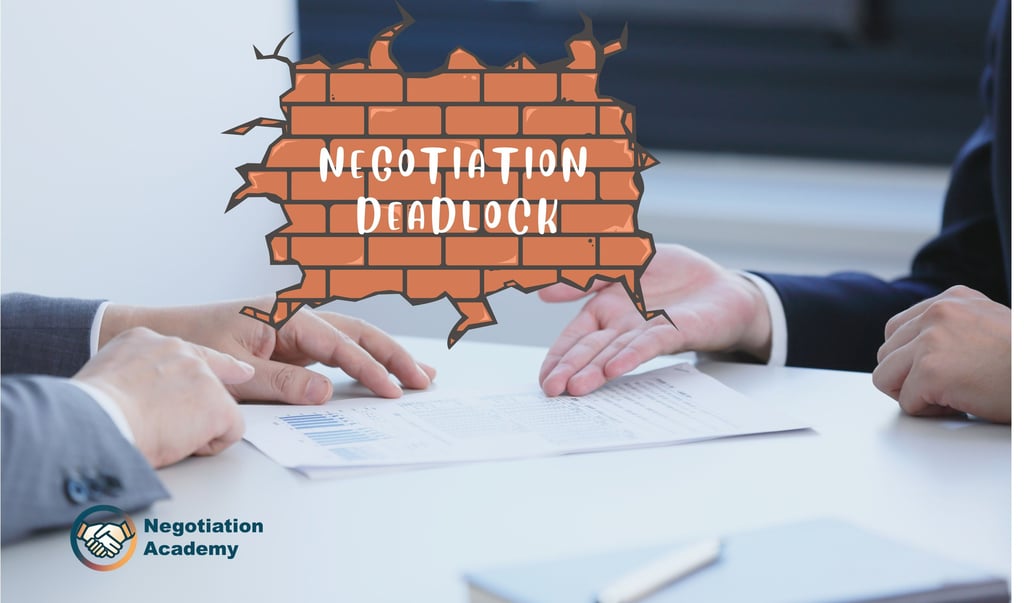
If you’ve negotiated long enough, you’ve been here.
You’re sitting across the table—or on a video call.
The deal should happen. On paper, it makes sense.
Yet somehow, you’re stuck.
Same points. Same arguments. Same tired logic going in circles.
That’s a deadlock.
And what makes it frustrating is not just the lack of progress—it’s the feeling that you’re burning time, energy, and goodwill while watching a perfectly workable deal slip out of reach.
This guide is about what actually helps when that happens. Not clever one-liners. Not aggressive negotiation tactics. But real, human ways of moving stalled conversations forward—especially when emotions, authority gaps, or rigid positions get in the way.
If you want to sharpen your negotiation skills and truly understand how to negotiate under pressure, this is where the learning really begins.
What a Deadlock Really Is (And What It Is Not)
A deadlock is often misunderstood. It’s not just disagreement. It’s not even tough bargaining.
A deadlock happens when:
Both sides dig in and hold on to their positions
The win-win mindset is missing and the conversation shifts to win-lose
Competitive negotiation style is adopted by the either side
Underlying interests, fears, or hidden concerns are never put on the table
Neither side is willing—or able—to make meaningful concessions
Trust is low, or the relationship isn’t strong enough to support tough conversations
The person with real decision-making authority isn’t in the room
Positions harden and alternatives stop being explored
Emotions quietly creep in—ego, frustration, irritation, and negotiation fatigue
You can see the deal.
You just can’t reach it.
And the more you push, the heavier it feels.
One early warning sign is repetition. When you hear the same points being made again and again—just louder or with more justification—you’re already close to a deadlock. Emotional escalation, withdrawal, or a sudden “this is non-negotiable” tone are other signals.
Spotting these early matters. Because once talks fully grind to a halt, recovery takes far more effort.
The First Defense Is Prevention (Most People Skip This)
Here’s something we emphasise repeatedly in negotiation skills training: The easiest deadlock to break is the one you never create. If deadlocks are anticipated during the preparation stage of a negotiation, you are far more likely to design the conversation in a way that avoids rigid positions, surfaces hidden concerns early, and builds room for trade-offs before emotions take over.
Preparation is not about scripting clever arguments. It’s about clarity.
Before you walk into any negotiation, you should know:
Where you are flexible
Where you are not
What trades you are willing to make
What your walk away point is
Equally important is preparing how you will listen. Skills like active listening, empathy, and asking open-ended questions keep discussions constructive long before they turn adversarial. They help you uncover what the other side truly cares about—often before positions harden.
Even with strong preparation, deadlocks still happen. That’s normal. The goal is not perfection. It’s recovery.
A Familiar Story: The “Final Price” Deadlock
A procurement leader once shared this with me during a workshop. Everything in the contract was settled—scope, volumes, service levels. Only price remained.
The supplier said, “This is our final price.”
The buyer responded, “That won’t work for us.”
Three meetings. Same exchange. No movement.
Classic deadlock.
What broke it wasn’t pressure or escalation. It was a shift in approach. Instead of countering again, the buyer asked: “Help me understand what makes this price non-negotiable for you.”
That one question unlocked the real issue—cost volatility in a specific raw material and fear of setting a precedent with other customers.
Once that came out, the discussion moved away from price vs price to risk sharing and structure. The final deal looked very different from the original one—but it worked for both sides.
That’s the power of actively listening to understand, not to reply.
When You Sense a Deadlock, Stop Pushing
Most people react to a deadlock by pushing harder.
More logic. More data. More urgency.
It feels productive. It’s usually counterproductive. Pressure narrows thinking. And narrow thinking is the enemy of progress.
When you sense resistance rising, pause and ask yourself:
Am I trying to win an argument—or move the deal forward?
Have we slipped into defending positions instead of solving a problem together?
Deadlocks thrive in positional battles.
Fix Emotions before Fixing the Problem
There’s a point in some negotiations where logic stops landing. When emotions run high—frustration, ego, resentment, fatigue—the negotiation is no longer about the issue. It’s about how people feel in the moment. And in that state, no amount of logic will break a deadlock.
This is an uncomfortable truth, but an important one.
Separate people from the problem. One of the most effective things you can do is to calmly acknowledge what’s happening.
Not with labels. Not with judgement. And definitely not with “you” statements.
Try something simple and human:
“It feels like this has become frustrating.”
“I sense this is starting to feel stuck for both of us.”
“This seems to be weighing heavier than just the numbers.”
When people feel their emotional state being acknowledged, they soften. When emotions are ignored, they escalate. Empathy, in contrast, often works like a release valve—it helps ease the emotional build-up and brings the conversation back to a calmer place.
This is not therapy. It’s emotional intelligence in negotiation.
Negotiation Academy, in their training programs, makes the participants practice "CALMED ™" technique to handle emotional reactions.
Separate the Position from the Reason
One of the simplest—and most effective—moves in negotiation is this: Don’t argue the position. Probe the reason behind it.
When someone says:
“We can’t agree to this clause”
“This is against policy”
“We’ve already stretched enough”
Treat that as a signal, not a wall.
Ask:
“What’s the concern behind this?”
“What risk are you trying to avoid?”
“What happens internally if this changes?”
These are not soft questions. They are smart ones. They lower defensiveness and often reveal room to manoeuvre that wasn’t visible earlier.
Negotiation Academy, in their training programs, lays emphasis on the practicing The Probing Techniques & Skills through Negotiation roleplays.
Active Listening: The Fastest Way to Loosen a Deadlock
If there is one skill that consistently unlocks stalled negotiations, it is active listening.
This means:
Listening to understand, not to counter
Acknowledging the other side’s concerns
Summarising what you’ve heard to confirm accuracy
When people feel heard, they soften. When they soften, they explore.
Avoid the common traps:
Interrupting
Dismissing concerns
Jumping to solutions too early
If agreement feels impossible, return to listening. It gives you the raw material to reframe the deal.
Use the Set-Aside Approach to Keep Momentum
One practical technique that works surprisingly well is the set-aside approach.
When a particular issue becomes a logjam:
Acknowledge its importance
Park it temporarily
Move forward on less controversial items
You might say: “This point clearly show up as important for both of us. Why don’t we set it aside for now and see if we can close the other pieces?”
This does two things:
Protects momentum
Builds a habit of agreement
As agreement accumulates, returning to the tough issue often becomes easier. People are more flexible when they feel progress—not stagnation.
Take Breaks—They’re Strategic, Not Weak
When discussions heat up, attention narrows. Emotions rise. Creativity drops. Negotiation fatigue creeps in.
This is where a well-timed break helps. A coffee break or a walk in the fresh air allows you to step aside from the deadlock and focus on rapport building. That softens the rigidness.
You don’t need to quote research to feel this—but studies on attention show that short breaks during prolonged tasks help people reset focus. Negotiations are no different.
A pause allows both sides to:
Reflect on what they’ve heard
Reassess positions
Cool emotional reactions
Sometimes changing the format—switching to written proposals or stepping away from the room—resets the dynamic completely.
A break is not avoidance. It’s often the fastest route back to clarity.
Get Into Each Other’s Shoes
Deadlocks rarely break when only one side is trying to be reasonable.
They break when both sides start seeing the situation through each other’s lens. I like this video that highlights this idea in a very interesting way.
Most negotiations stall because each party is focused on protecting their own position—while guessing, often incorrectly, what the other side is thinking. When that happens, assumptions replace understanding, and positions harden.
Getting into each other’s shoes means slowing the conversation down and asking a different set of questions—not about the deal, but about the real pressures on both sides.
Before expecting the other party to open up, get clear about your own realities:
What risks are you trying to manage?
What constraints are you operating under?
What would failure look like for you internally?
Then turn the lens outward:
What pressures might they be under?
What are they accountable for if this goes wrong?
What would make this decision uncomfortable or risky for them?
When both sides articulate these openly, the negotiation shifts from bargaining to understanding.
Bring It Into the Conversation. You don’t need to frame this as empathy or psychology. Keep it practical:
“Let me share what’s driving this on our side.”
“Can you help me understand what’s making this hard for you?”
“What would success need to look like internally for you to feel comfortable with this?”
These questions invite honesty without putting anyone on the defensive.
When real pains and concerns surface—budget cycles, approvals, reputation risk, workload, past failures—the deadlock often loosens on its own.
Deadlocks are sustained by unspoken fears. One side fears setting a precedent. The other fears losing credibility. Both sides fear being blamed later.
Once those fears are out in the open, the conversation changes. You can start designing solutions that address both sets of concerns instead of arguing over positions.
Treat the Deadlock as a Joint Problem
A deadlock becomes destructive only when it turns into me vs you. Reframe it as us vs the problem.
You can do this explicitly: “It feels like we’re stuck. Instead of pushing, can we step back and solve this together?”
That single sentence often changes the tone.
From there, use a simple collaborative rhythm:
Reframe around shared goals
Take short breaks if needed
Brainstorm options without judgement
Separate people from the problem
Reintroduce the tough issue after progress elsewhere
This approach lowers defensiveness and invites creativity.
Re-Establish Common Ground When Positions Harden
When negotiations stall, people forget what they actually agree on.
Bring it back. Talk about:
Shared risks
Long-term relationship value
Mutual dependencies
What success looks like for both sides
Shift the language from what we want to what we both need. Most importantly, bringing relationship value on the forefront often changes the perspective.
If one issue remains immovable, set it aside again and keep the wider discussion moving. Momentum has a way of softening rigidity.
Shift Discussions from Opinions to Objective Criteria
Opinions escalate conflict. Data grounds it.
Objective criteria like:
Market benchmarks
Industry practices
Historical performance
Neutral expert inputs
help shift the discussion from personalities, opinions to logical reasoning.
The key is tone. Not: “You’re wrong.” But: “Let’s check how this compares to the market and see what feels reasonable.”
This reduces ego and reframes compromise as prudence, not weakness.
Generate Real Win-Win Outcomes (Not Split-the-Difference Deals)
A win-win outcome is not about meeting halfway. It’s about expanding value. That means:
Brainstorming without judgement
Challenging assumptions
Looking for trades that matter differently to each side
Ask:
“What would make this genuinely work for you?”
“What else could we include that adds value without adding cost?”
When you’re stuck, return to creativity. Deadlocks dissolve when the pie grows.
When a Deadlock Is Driven by Mistrust
Some deadlocks have nothing to do with the deal itself. They exist because trust is missing.
When mistrust is present, every proposal is questioned, concessions feel risky, and even reasonable ideas are met with suspicion. In that state, logic and persuasion rarely work.
Start by recognising the source. Mistrust often comes from past experiences, broken commitments, power imbalances, or lack of transparency. If trust is the issue, pushing harder on terms only deepens resistance.
Instead of trying to convince, focus on showing reliability. Be clear about what you can and cannot do. Avoid over-promising. Consistency builds confidence faster than persuasion.
Use small, low-risk commitments to rebuild trust—pilots, phased agreements, short review cycles. Each kept commitment matters more than a big promise.
Increase transparency, especially around constraints and risks. People may not like your limits, but they respect clarity.
When personal trust is low, rely on process: clear milestones, written summaries, objective benchmarks, and agreed review points. Structure creates safety when relationships cannot yet do so.
Finally, accept that trust takes time. Some deadlocks won’t break in one meeting. Focus on making progress feel safe, not fast. When mistrust eases, movement follows.
Know When to Walk Away—Quietly
Every negotiator needs a walk away point.
Not to threaten. To stay grounded. If you don’t know it, you’ll either:
Concede too much
Or stay stuck far too long
Clarity gives confidence. Confidence reduces desperation. And desperation fuels deadlocks.
You don’t need to announce your walk away. You just need to respect it.
A Training Room Insight
During a program at Negotiation Academy, a participant shared this: A distributor kept delaying agreement with “We’ll get back.”
Instead of escalating, he asked: “What’s making this decision difficult on your side?”
The issue wasn’t the deal. It was fear of internal resistance.
They redesigned the proposal as a pilot. The deadlock disappeared.
Not because of tactics—but because of understanding.
Putting It All Together
Breaking a deadlock in negotiation is rarely about one clever move.
It’s about combining:
Preparation and clarity
Active listening and empathy
Strategic breaks and process changes
Creativity and objective anchors
Knowing when to pause—and when to walk away
That’s what real negotiation capability looks like.
At Negotiation Academy, these habits are built through practical negotiation skills training across Procurement, Sales, and Internal Stakeholder negotiations—so teams don’t just know the theory, they can apply it under pressure.
Deadlocks will happen. The question is whether you freeze—or know how to move.
One Last Thought
The next time a negotiation stalls, don’t ask: “How do I break this deadlock?”
Ask: “What am I missing right now?”
That question alone often opens the door.
Frequently Asked Questions: Breaking Deadlocks in Negotiation
What is a deadlock in negotiation?
A deadlock in negotiation happens when discussions stall and neither side is willing—or able—to move forward. Positions harden, alternatives stop being explored, and emotions or mistrust often take over, making progress difficult.
Why do negotiations reach a deadlock?
Negotiations usually reach a deadlock when both sides hold on to fixed positions, underlying concerns remain unspoken, trust is low, emotions run high, or the person with real decision-making authority is not involved.
How can you break a deadlock in negotiation?
Deadlocks can be broken by slowing the conversation down, acknowledging emotions, practising active listening, reframing the problem around shared goals, expanding options, and sometimes taking a strategic pause to reset the discussion.
What role do emotions play in negotiation deadlocks?
Emotions like frustration, ego, or fatigue can block logical thinking. When emotions are high, logic and probing questions often stop working. Acknowledging emotions and showing empathy helps lower tension and reopen dialogue.
Does taking a break help resolve a negotiation deadlock?
Yes—but not always on its own. Breaks help cool emotions and restore focus, but if mistrust or deeper concerns exist, the negotiation may also need reassurance, transparency, or a change in approach to move forward.
How does active listening help break a deadlock?
Active listening helps people feel heard and understood. When parties feel acknowledged, defensiveness reduces, emotions soften, and it becomes easier to explore alternatives and work toward a win-win outcome.
What should you do if mistrust is causing the deadlock?
When mistrust drives a deadlock, stop trying to persuade. Focus instead on reliability, transparency, and small, low-risk commitments such as pilots or phased agreements. Trust rebuilds through actions, not arguments.
How does “getting into each other’s shoes” help in negotiations?
Seeing the situation from each other’s perspective helps uncover real pressures, risks, and fears on both sides. This mutual understanding often reveals new ways to structure agreements that feel safer for everyone.
When should you walk away from a deadlocked negotiation?
You should consider walking away when the deal no longer meets your minimum requirements, trust cannot be rebuilt, or continued negotiation risks long-term damage. Knowing your walk-away point keeps decisions grounded and confident.
Is a win-win outcome always possible in a deadlock?
Not always—but many deadlocks break when value is expanded rather than split. A win-win outcome comes from understanding interests, not positions, and creatively designing solutions that address what matters most to both sides.
How can preparation help prevent negotiation deadlocks?
Good preparation helps you clarify your walk-away point, anticipate pressure points, plan trade-offs, and recognise early warning signs. The easiest deadlock to break is often the one you never create.
What negotiation skills are most important for handling deadlocks?
Key skills include active listening, empathy, emotional control, reframing issues, creative problem-solving, and knowing when to pause or walk away. These are core capabilities taught in structured negotiation skills training.
Where can professionals learn practical negotiation skills?
Organisations like Negotiation Academy focus on real-world negotiation skills training that helps professionals prevent deadlocks and resolve them effectively when they arise.
Subscribe
Contact:
P2/54 DLF Phase 2 Gurugram 122002
contact@advanchainge.com
+91-9873829286
deepak.nande@advanchainge.com
+91-9820291969