Contact for Negotiation Skills Training for your Teams: contact@advanchainge.com | +91-9873829286
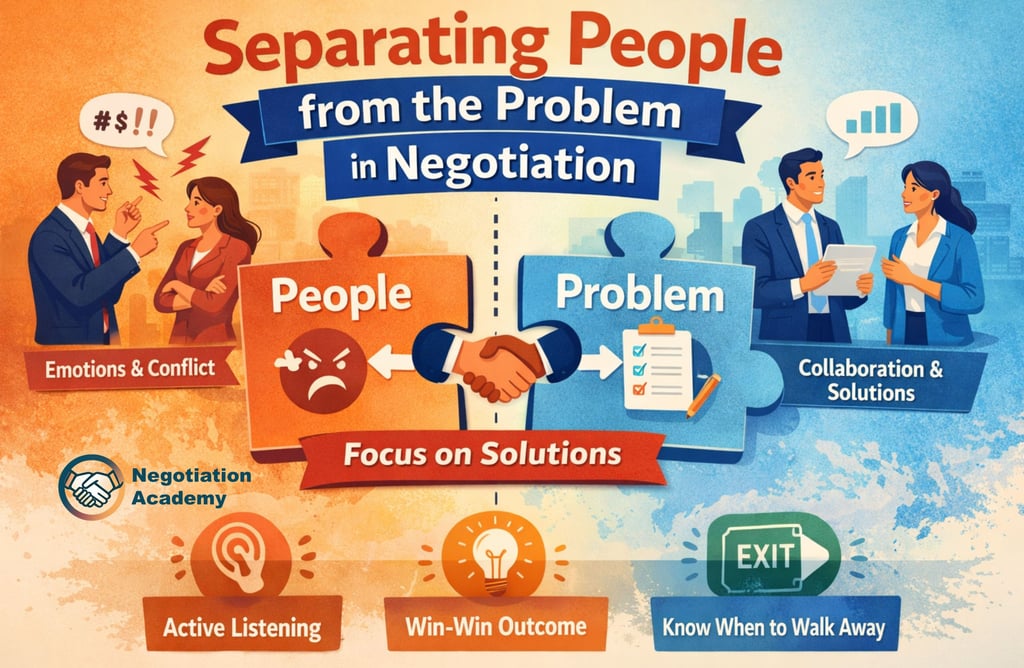
Separating People from the Problem in Negotiation
Separating People from the Problem in Negotiation helps you avoid emotional deadlocks, protect relationships, and negotiate smarter—even in high-pressure business situations.
NEGOTIATION STRATEGIESDIFFICULT NEGOTIATIONSEMPATHYPRINCIPLED NEGOTIATIONLEADERSHIP NEGOTIATIONBUSINESS NEGOTIATIONWIN-WIN NEGOTIATIONEMOTIONS IN NEGOTIATIONGETTING TO YESART OF NEGOTIATIONWILLIAM URYROGER FISHER
Ashish Mendiratta
1/30/20265 min read
A Core Negotiation Skill for Better Outcomes, Stronger Relationships, and Fewer Deadlocks
Negotiation rarely fails because the numbers don’t work.
It fails because people take things personally.
A delayed delivery becomes an insult.
A pricing pushback feels like disrespect.
A tough question sounds like an attack.
And before anyone realizes it, the negotiation is no longer about solving a problem—it becomes about defending ego, emotion, and position.
That’s why one of the most important negotiation skills is separating people from the problem. It’s simple to say, hard to practice, and incredibly powerful when done well. In the book "Getting to Yes: Negotiating Agreement Without Giving In", the authors Roger Fisher and William Ury introduce separating the people from the problem as a foundational principle of principled negotiation. The key idea is simple : Be soft on the people and hard on the problem. Not soft as in weak. Soft as in respectful, calm, and attentive.
This article breaks down what it really means, why it matters, how it shows up in real negotiations, and how professionals actually apply it in business, procurement, sales, and leadership negotiations.
What Does Separating People from the Problem Mean in Negotiation?
Separating people from the problem means dealing with the relationship and the issue as two different things.
The problem could be:
Price
Quality
Delivery
Scope
Payment terms
Risk sharing
The people bring:
Emotions
Stress
Past experiences
Fear of losing face
Pressure from internal stakeholders
When these get mixed, discussions escalate fast.
Instead of: “We have a delivery issue”, the conversation becomes: “You don’t care about our business.”
Once that happens, logic stops working.
Why This Skill Is Critical in Today's Negotiations
Today’s negotiations happen in a far more volatile and uncertain environment:
Geopolitical uncertainty
Tight timelines
Virtual settings
High performance pressure
Reduced face-to-face interaction
This makes misunderstandings more likely and emotions harder to read.
Professionals who fail to separate people from the problem in negotiation often:
Escalate conflicts unnecessarily
Damage long-term relationships
Miss win-win outcomes
Walk away too early—or too late
This is why separating people from the problem sits at the heart of how to negotiate effectively, not just politely.
The Most Common Mistake Negotiators Make
The biggest mistake is assuming intent instead of focusing on impact.
Examples:
“They’re trying to squeeze us.”
“They’re being unreasonable.”
“They don’t respect our constraints.”
In reality, most negotiators are reacting to pressure—not plotting against you.
When intent is assumed, defensiveness rises. When impact is discussed, solutions emerge.
Real-World Example: Procurement Negotiation Gone Wrong
A buyer says: “Your team keeps missing deadlines.”
The supplier hears: “You are incompetent.”
The supplier responds: “Your forecasts are always inaccurate.”
Now the discussion is no longer about delivery capability. It’s about blame.
Had the buyer said: “We have a delivery issue that’s affecting production schedules.” The problem stays external—and solvable.
The Role of Emotions in Negotiation (Even in Business Deals)
Many professionals believe negotiation should be “objective.” That’s unrealistic. People care about:
Respect
Recognition
Fairness
Control
When these are threatened, they stop listening.
This is where empathy and active listening becomes a serious negotiation tactic—not a soft skill.
Simple acknowledgments like:
“I hear the pressure you’re under.”
“That sounds frustrating.”
“Let me make sure I understand your concern.”
These don’t weaken your position. They stabilize the conversation.
How to Separate People from the Problem: A Practical Framework
1. Address Emotions Before Solving the Issue
Ignoring emotion doesn’t make it disappear. Name it calmly:
“This seems to be causing frustration.”
“I sense some concern around this point.”
Once emotions are acknowledged, rational discussion becomes possible.
2. Turn the Problem into a Shared Challenge
Shift language from you vs me to us vs the issue.
Instead of: “You’re not flexible.” Say: “We seem stuck on this point—let’s see how we can unblock it.”
This small change reduces defensiveness instantly.
3. Ask Questions That Invite Explanation, Not Defense
This is one of the most practical ways of separating people from the problem in negotiation. Good negotiators don’t accuse. They separate the relationship from the issues. They explore. The art of subtle probing to uncover the hidden motivations and interests goes a long way in understanding the root cause of defensiveness. This is one of the most practical ways of separating people from the problem in negotiation.
Examples:
“What’s making this difficult on your side?”
“What constraints should we factor in?”
“What would make this workable for you?”
"What if we take care of your concern of price volatility, would you be open to our offer?"
These questions create dialogue, not resistance.
4. Separate Intent from Impact Explicitly
One powerful line: “I’m not questioning intent, but the impact on our side is serious.”
This keeps accountability without personal attack.
Separating People from the Problem in Tough Negotiations
Price Negotiations
Supplier says: “At this price, it doesn’t make sense.”
Buyer response that escalates and shift the focus from the problem to people: “Then you’re not competitive.”
Better response: “Help me understand what cost drivers are creating this gap.”
Same issue. Very different direction.
Internal Stakeholder Negotiations
Operations says: “Procurement always delays things.”
Bad response: “You never plan properly.”
Better response: “We seem misaligned on timelines—let’s map where the breakdown is.”
The problem stays process-based, not personal.
When Separating People from the Problem Still Leads to a Walk Away
This skill doesn’t mean forcing agreement. Sometimes the problem genuinely has no acceptable solution that leads to a walk away from a negotiation. The difference is how you walk away.
A professional walk away sounds like: “We’re aligned on the relationship, but not on the terms. It may be better to pause here.”
This preserves respect, credibility, and future opportunity.
How This Enables Win-Win Outcomes
Win-win doesn’t mean compromise for the sake of peace. It means:
Interests are understood
Trade-offs are explored
Relationships aren’t damaged
You can only reach that space when people don’t feel attacked.
Separating people from the problem creates room for:
Creative options
Phased solutions
Risk-sharing models
Value-based trades
Why This Skill Is Central to Negotiation Skills Training
Most negotiation failures aren’t technical. They’re emotional and behavioral.
That’s why high-quality negotiation skills training focuses on:
Language framing
Emotional control
Listening under pressure
Managing ego—yours and theirs
At Negotiation Academy, this skill is practiced through real scenarios, not theory—because separating people from the problem only works when you can apply it in the moment.
Key Takeaway
If there’s one mindset shift that improves negotiation instantly, it’s this: The person across the table is not the problem. The problem is the problem.
Remember that—and your negotiations will become calmer, smarter, and far more effective.
Frequently Asked Questions
What does separating people from the problem mean in negotiation?
Separating people from the problem means handling the relationship and the issue as two different things. Instead of blaming or personalising disagreements, negotiators focus on solving the actual problem while maintaining respect and trust between people.
Why is separating people from the problem important in negotiation?
Because most negotiations fail due to emotions, not logic. When people feel attacked or disrespected, they stop listening. Separating people from the problem helps reduce defensiveness, keep discussions objective, and improve the chances of reaching a win-win outcome.
Is separating people from the problem a soft skill or a negotiation tactic?
It is both. It requires empathy, emotional awareness, and active listening, but it is also a powerful negotiation tactic. By keeping the focus on the issue instead of the person, negotiators gain more control over the conversation and outcomes.
Can separating people from the problem work in high-pressure or hard negotiations?
Yes. In fact, it becomes even more important in high-pressure negotiations. When stakes are high, emotions run stronger. Separating people from the problem allows negotiators to stay firm on issues without damaging relationships or escalating conflict.
What happens if you don’t separate people from the problem in negotiation?
When people and problems get mixed, negotiations often turn personal. Positions harden, trust erodes, and communication breaks down. This can lead to poor agreements, damaged relationships, or an unnecessary walk away from the negotiation.
How is separating people from the problem taught in negotiation skills training?
In effective negotiation skills training, this skill is taught through real scenarios, role plays, and feedback. Participants practice handling emotions, reframing language, and addressing issues without attacking people—so the skill works under real pressure, not just in theory.
Subscribe
Contact:
P2/54 DLF Phase 2 Gurugram 122002
contact@advanchainge.com
+91-9873829286
deepak.nande@advanchainge.com
+91-9820291969